
— Ben Laube Homes Blog
Moving to Tampa from Out of State: What You Need to Know
Tampa draws tens of thousands of out-of-state movers every year — mostly from New York, New Jersey, California, and the Midwest. The pitch is familiar: no state income tax, cheaper housing, 250+ days of sunshine, and the beach is actually close. Most of that is true. What the pitch skips is hurricane season, insurance costs, flood zone math, and the fact that I-275 at 5 PM will make you miss wherever you came from.
I work with relocating buyers regularly. This guide covers the questions they ask after the initial excitement wears off — the stuff that shapes whether Tampa actually works for your household.
The Tax Picture
Florida has no state income tax. Full stop. If you are moving from New York (up to 10.9% marginal rate), California (up to 13.3%), or New Jersey (up to 10.75%), the savings are significant. A household earning $200,000 in New York City keeps roughly $20,000 to $25,000 more per year in Florida after accounting for state and city income taxes.
Florida funds state services through sales tax and property taxes instead. The combined sales tax rate in Hillsborough County (which includes Tampa) is 7.5% — 6% state plus 1.5% county. Pinellas County (St. Petersburg, Clearwater) is 7%. That is higher than most Northeastern states.
Property taxes in Hillsborough County run roughly 1.0% to 1.3% of assessed value annually before exemptions. Buy a $500,000 home and you are looking at $5,000 to $6,500 per year in property taxes. Florida Save Our Homes homestead exemption caps your assessed-value increase at 3% per year once you establish primary residency — real protection against runaway tax bills over time. But year one is based on purchase price. See the full breakdown at /blog/florida-property-tax-cap-save-our-homes.
What Things Actually Cost
Tampa median home price as of early 2026 sits around $420,000 to $450,000 depending on the sub-market. South Tampa runs higher — expect $550,000 to $900,000 for single-family homes in Hyde Park and Palma Ceia. New Tampa and Carrollwood are $350,000 to $550,000. Brandon and Wesley Chapel give you the most square footage per dollar, with entry-level single-family starting around $320,000.
Rent averages $2,000 per month for a one-bedroom and $2,400 to $2,800 for a two-bedroom in the city core. That is 30% to 40% cheaper than Manhattan or San Francisco, but not as cheap as people expect compared to inland metros.
- Groceries: roughly in line with national average — Publix is the dominant chain, well-stocked and mid-range priced
- Utilities: higher than most of the country. AC runs 8 to 9 months here. Budget $200 to $280 per month for electric, water, and internet combined
- Gas: Florida prices track Gulf Coast refinery rates — typically $0.20 to $0.30 below Northeast prices
- Dining out: Tampa has a real food scene (Ybor City, Hyde Park Village, Armature Works) with prices similar to mid-size metros — $15 to $30 per person at sit-down restaurants
- Childcare: $1,200 to $1,800 per month for full-time daycare — comparable to the Northeast, not cheaper
The Insurance Reality
This is where the cost-of-living pitch gets complicated. Florida home insurance has increased dramatically since 2020. On a $450,000 home not in a flood zone, expect $3,500 to $6,000 per year for wind and hazard coverage. That is $300 to $500 per month added to your mortgage payment — before flood insurance.
Flood insurance is separate from homeowners insurance and is required by lenders if your home falls in FEMA Special Flood Hazard Area (Zones AE or VE). Even in Zone X — the lowest-risk designation — many Tampa buyers add a private flood policy at $500 to $1,200 per year. Post-Helene and Milton (the back-to-back hurricanes that hit the Tampa Bay region in fall 2024), flood zone awareness has sharpened considerably.
Read the full breakdown at /blog/hurricane-insurance-guide-florida and /blog/florida-flood-zone-explainer before you make an offer on any Tampa Bay property.
“The number that surprises out-of-state buyers most is not the home price — it is the insurance stack. On a waterfront or flood-zone property, combined wind and flood premiums can add $12,000 to $18,000 per year. Model that before you fall in love with the view.”
Hurricane Season: The Honest Version
Hurricane season runs June 1 through November 30. Tampa Bay went decades without a direct major hurricane hit — a statistical anomaly that ended with Helene (September 2024, Category 4 landfall at the Pinellas coast) and Milton (October 2024, Category 3 landfall near Siesta Key). Storm surge from Helene flooded substantial parts of Pinellas County, including Shore Acres, Treasure Island, and portions of St. Pete Beach.
What this means for buyers: flood zone designation is now a first-order question, not an afterthought. Buyers are scrutinizing elevation certificates, pulling FEMA flood maps, and running insurance quotes before making offers. Sellers in flood-affected areas are disclosing material damage. The market has priced in risk in coastal areas — expect meaningful discounts on homes with flood history.
Inland Tampa — Carrollwood, New Tampa, Wesley Chapel, Brandon — carries substantially lower flood risk. These areas typically fall in Zone X, meaning flood insurance is optional. Wind damage is still possible anywhere in Florida, but the storm surge that drives catastrophic losses does not reach 20-plus miles inland.
Tampa vs. South Tampa vs. New Tampa vs. Brandon vs. Wesley Chapel vs. Carrollwood
Tampa metro is not one place — it is a collection of very different sub-markets within Hillsborough County, each with its own price range, commute profile, school district, and character. Here is how they compare:
South Tampa (Hyde Park, Palma Ceia, Bayshore)
South Tampa is the premium address. Hyde Park Village has the boutiques and restaurants. Bayshore Boulevard has the waterfront running path. Schools include Plant High School — consistently one of the top-ranked publics in Hillsborough County. Prices: $600,000 to $1.2M for single-family in Hyde Park and Palma Ceia, with some blocks higher. Flood zones vary — streets near Bayshore and Old Tampa Bay carry AE designations. Check before you offer. More at /communities/hyde-park.
Seminole Heights and Tampa Heights
These two neighborhoods north of downtown are the bungalow belt — craftsman-style homes, walkable commercial strips, independent restaurants, and coffee shops. Seminole Heights has Angry Chair Brewing, Rooster and the Till, and a genuine neighborhood feel. Tampa Heights has Armature Works riverfront and rapid appreciation over the past five years. Entry-level single-family: $350,000 to $500,000. Flood risk is low in most of both neighborhoods (Zone X). See /communities/seminole-heights and /communities/tampa-heights.
Ybor City
Ybor is Tampa historic Latin Quarter — 7th Avenue, the cigar culture, brick-paved streets. It is an entertainment district first but a growing residential market. Condos and renovated historic buildings appeal to buyers who want walkability and urban feel without paying downtown Miami prices. Nightlife is real; if late-night noise bothers you, look elsewhere. See /communities/ybor-city.
Carrollwood and Westchase
Northwest of downtown, Carrollwood is established suburban Tampa — good schools, tree-lined streets, community pools, mostly ranch-style homes from the 1970s through 90s. Prices: $380,000 to $550,000. Westchase is a planned community with newer construction, A-rated schools, and active HOAs. Both have easy access to the Veterans Expressway and SR-589 for downtown commutes. See /communities/westchase.
New Tampa
New Tampa occupies the northeast corner of Hillsborough County, bordering Wesley Chapel. It is master-planned, suburban, and family-oriented — good schools, low crime, newer construction from the 1990s through 2010s. Median prices: $400,000 to $575,000. The trade-off is commute: 30 to 45 minutes to downtown Tampa during peak hours.
Brandon and Riverview
Brandon sits east of Tampa on SR-60, offering the most square footage per dollar in the close-in metro. A 2,000-square-foot home that costs $600,000 in South Tampa typically runs $360,000 to $425,000 in Brandon. The catch is I-75 and I-4 interchange traffic — one of the most congested chokepoints in Florida. Budget 45 to 60 minutes to downtown Tampa at rush hour from Brandon.
Wesley Chapel
Wesley Chapel is Pasco County, not Hillsborough — an important distinction because school districts, county tax rates, and services differ. New construction dominates: master-planned communities with amenity centers, pools, and HOAs. The Epperson lagoon (a 7.5-acre crystal-clear lagoon, resident-accessible) is a legitimate draw. Schools rank well. Median prices: $420,000 to $510,000 for new construction. Commute to downtown Tampa: 35 to 55 minutes via I-75. See /communities/wesley-chapel.
Traffic and Commutes
Tampa has a car-dependent infrastructure problem. The highway system was designed for a much smaller metro. HART (the bus network) is underfunded. There is no light rail. The consequence: if you live outside the urban core and commute to a downtown job, you will spend significant time in traffic.
The worst chokepoints: the Howard Frankland Bridge (I-275 crossing Tampa Bay to St. Petersburg), the I-75 and I-4 interchange near Brandon, and I-275 north of downtown toward USF. Peak inbound congestion runs 7:15 to 8:30 AM. Peak outbound is 5:00 to 6:30 PM. Leaving downtown before 4:15 PM or after 6:30 PM cuts 20 to 30 minutes off most drives.
If your job is downtown Tampa: South Tampa, Tampa Heights, Seminole Heights, Ybor, and Channelside are all short commutes. If you work in Wesley Chapel or the I-75 north corridor, New Tampa or north Pasco make more sense than fighting inbound traffic from south or west.
Schools
Hillsborough County School District is large — 259 schools, over 230,000 students — which means school quality varies enormously by zone. Top-ranked publics: Plant High (South Tampa), Sickles High (Carrollwood and Westchase), Steinbrenner High (Lutz and Carrollwood border), and Wharton High (New Tampa). All have strong AP programs and graduation rates above 90%.
Hillsborough magnet programs are extensive — IB, STEM academies, arts magnets. Acceptance is competitive and requires an application, but it opens options for families not zoned to the highest-ranked schools. If schools are a priority, ask for the school zone before you make an offer, not after.
The Beach Question
Clearwater Beach is 30 to 40 miles from central Tampa — roughly 40 to 60 minutes by car depending on traffic. St. Pete Beach and Fort De Soto are 25 to 35 miles. These are not walk-to-the-beach situations from most of the city. They are accessible for a weekend day trip. Many Tampa residents go two or three times a month without making a production of it.
If beach proximity is non-negotiable and you want to see the Gulf from your neighborhood, look at Pinellas County instead: St. Pete, Clearwater, Dunedin, Gulfport, Seminole. Prices are higher, flood zones are more complex, but the geography is right. The companion guide at /blog/moving-to-st-petersburg-from-out-of-state covers that side of the bay in depth.
Before You Make an Offer: The Relocation Checklist
- Pull the flood zone on the specific property — use FEMA Flood Map Service Center or ask your agent for the elevation certificate.
- Get insurance quotes before you are under contract. A $450,000 home in Zone AE can run $10,000 to $15,000 per year in combined wind and flood premiums. Know the number before you offer.
- Check the school zone at Hillsborough County official school finder — do not rely on listing descriptions for school zone information.
- Drive your actual commute at actual rush hour before you commit. Sunday at noon is not your commute.
- Request a 4-point inspection on any home 25 or more years old. Florida insurers require it; it surfaces roof, electrical, plumbing, and HVAC condition before you are bound.
- Review HOA and CDD documents if applicable. CDDs (Community Development Districts) are common in master-planned communities like Wesley Chapel and New Tampa — they add $1,000 to $3,000 per year in assessments on top of HOA dues.
- Understand homestead exemption timing. Apply by March 1 of the year following purchase to capture the $50,000 exemption and begin the Save Our Homes cap.
- Talk to a Florida-licensed lender before you contact agents. Pre-approval shapes what you can realistically offer — and in Tampa competitive sub-markets, it is table stakes.
Bottom Line
Tampa works for a lot of people coming from high-cost, high-tax states. The tax savings are real. The housing cost advantage over coastal California and the Northeast is real. The lifestyle — weather, outdoor access, a food scene, relative density without Manhattan crowding — is legitimate.
What requires honest planning: insurance costs, flood zone diligence, and traffic. Those three variables shape whether your Tampa budget works or does not. Model them before you are under contract.
If you want a direct conversation about which Tampa-area sub-market fits your income, your commute, and your risk tolerance, reach out. I work with relocating buyers from out of state every month.
Nearby
Neighborhoods featured in this post
Westchase
Tampa
Westchase is a 2,000-acre master-planned community in northwest Tampa — 3,514 homes in 33 neighborhoods built around an 18-hole golf course…
Featured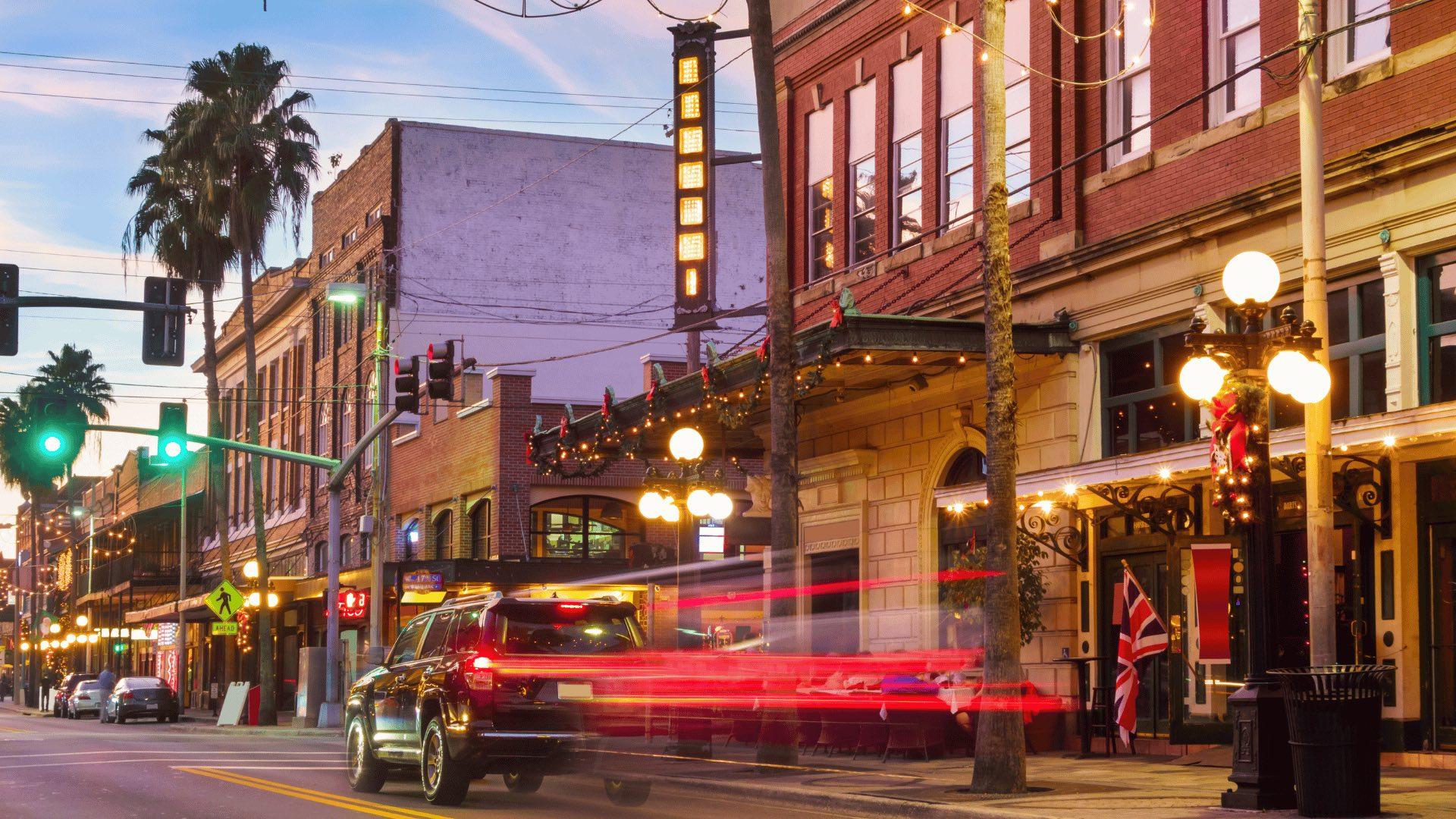 Featured
Ybor City
Tampa
Ybor City is Tampa's historic cigar district — a National Historic Landmark neighborhood of century-old brick factories, casita cottages, a…
New Tampa
Tampa
New Tampa is a 24-square-mile collection of master-planned communities along Bruce B. Downs Boulevard — annexed by Tampa in 1988 and built…
Featured Featured
Shore Acres
St. Petersburg
Shore Acres is a northeast St. Petersburg peninsula neighborhood where water borders three sides — Old Tampa Bay, Smack's Bayou, and Pappy'…
Questions about your own market?
Reach out for a tailored take on your neighborhood, timeline, or price band.